Ssangyong Rodius Review

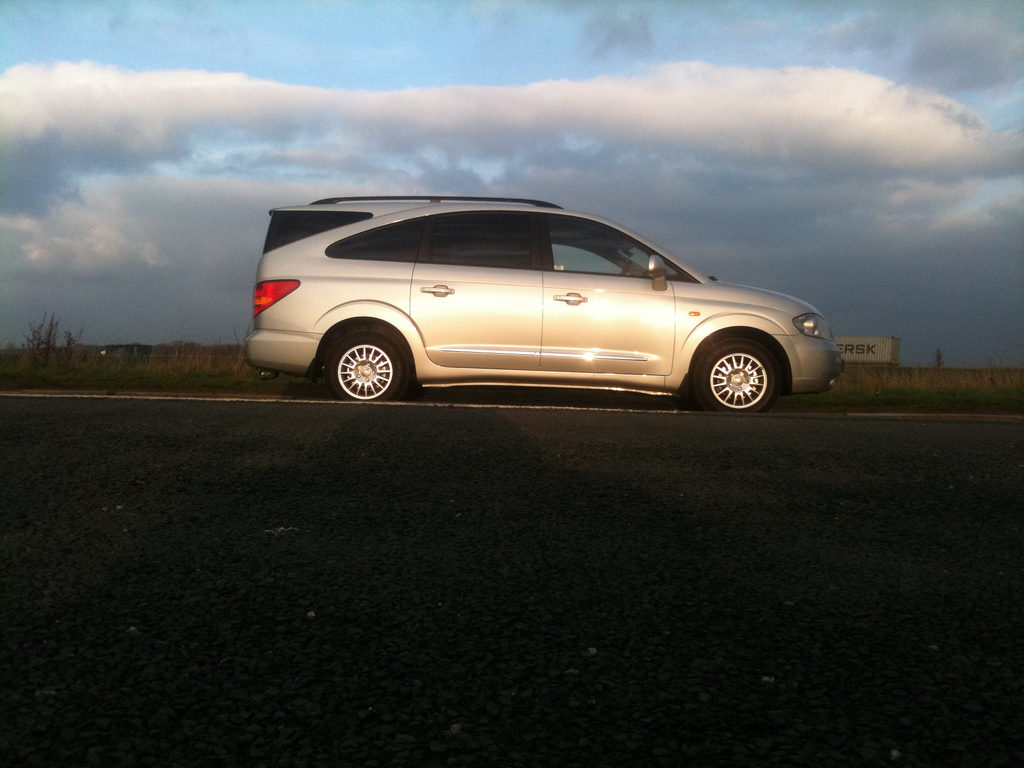
In 2011 I reviewed the Ssangyong Rodius. I accepted the challenge of finding something nice to say about this dog of a car – and trying to make it look nice in some late-aftrnoon sun…

The Ssangyong Rodius has the dubious distinction of the car most frequently mentioned as being the ugliest on UK roads. And it is very ugly indeed.

The proportions – from the snub nose – to the rear third, which seems to go on forever, are just awful to look at. The attempt to give the Rodius a more streamlined profile by trying to fool the eye with a curvy, coupe-like false line at the back is like putting a beauty spot on the face of Ian Dowie. The new Korando wears its understated-yet-smart Guigiaro looks well. But the Rodius, well, it’s a mess.

But I like a challenge. I don’t spend much time on taking pictures of cars – and don’t pretend these approach professional shots in terms of quality – but I like to try and take some nice shots of every new car I drive. It’s not always possible; it’s rarely easy, but I think a new image of a car really adds something to copy.

With that in mind I climbed into the Ssangyong knowing I had a real job on my hands. But the sun was low, there was a good spot by the road and a reasonably clean background with some nice clouds in the sky.

So, by my reckoning, this is as good as it’s possible to make the Ssangyong Rodius look. I’m prepared to consider alternative suggestions, but I doubt that many people have tried.

If I’m remembered for one thing in the motoring industry, let it be this. My attempt to make the Ssangyong Rodius beautiful. Judge for yourselves whether I’ve succeeded or not.

6388294151_7cef9cf058_b

The Ssangyong Rodius doesn’t have much a reputation and, it’s probably fair to say, the reputation that it does have is not an enviable one.

Chiefly known for its fugly styling, the Rodius is a genre-bending car that’s pitched mid-way between van, MPV and SUV. Why van? Well, because it’s absolutely ginormous inside and actually has a gangway through the middle, running from the front seats to the rear bench. It’s pretty clattery and wobbly and unrefined too.

Why SUV? Because it can be specced with four-wheel drive (rear-wheel drive is standard) and a grunty turbodiesel engine that makes it pretty useful for towing.

Why MPV? You can carry seven in the unusual 2+2+3 seating layout; you can swivel the middle seats around so they’re facing inwards or backwards; and the binnacles, oh the binnacles… there are binnacles everywhere.

The Rodius is not a nice car, but it’s the most intriguing car I’ve ever driven. It feels like something from a generation ago in terms of refinement and quality. It looks like some enormous American station wagon inside; a vast people-swallower designed for long, straight highways.
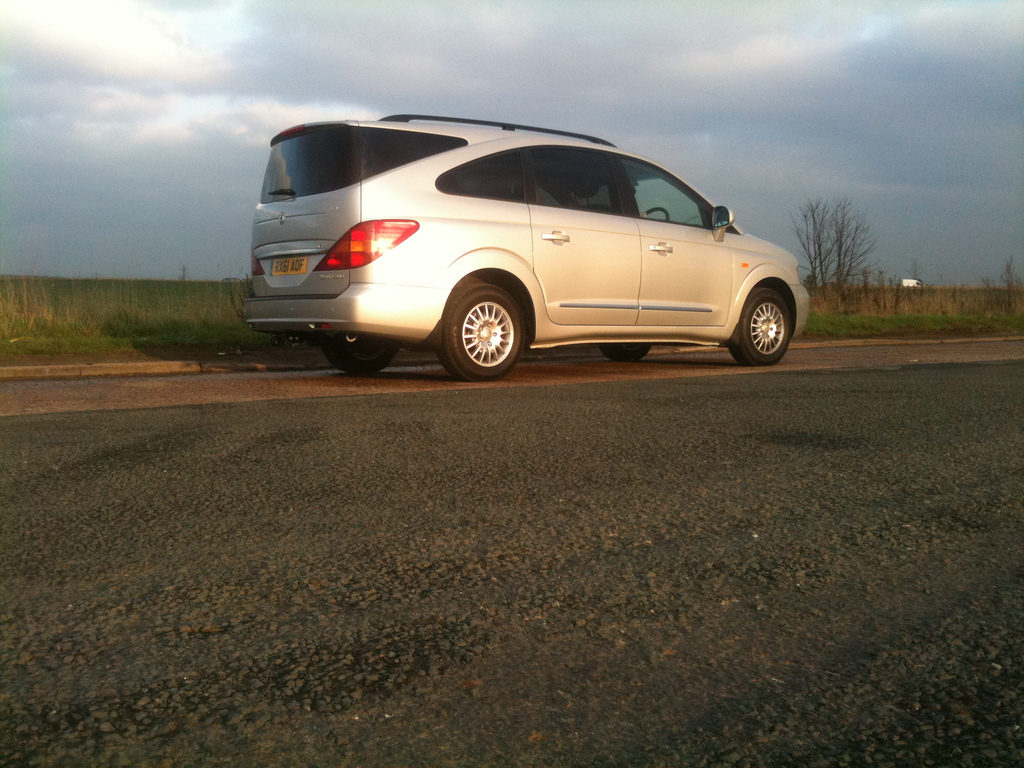
6388294921_bd68c0614e_b

It sounds like a lawnmower, equipped with a weirdly peaky, shrill turbodiesel lump with a
forgetful auto transmission that hangs onto gears so long you fear catastrophic engine failure.

Yet people buy it – and people are loyal to the Ssangyong brand. As the company slogan used to say, it works for them (they’ve since changed it to ‘what’s stopping you?’). There probably isn’t a cheaper way to transport seven people – plus a decent luggage space – in comfort.

Prices in the Rodius range start at £14,995, making it second only to the outgoing Vauxhall Zafira in the sector among such models as far as cost is concerned. You can scarcely get a cheaper seven-seater – and if you compare what else retails at around £15K it’s clear that the Rodius is an absolute bargain.

Sure, depreciation will ensure the big Ssangyong takes a hit, but I find it hard to believe that many Rodius buyers will be looking to sell up after three years. Consider the five-year, unlimited-mileage warranty too…

Dimensions and interior

The middle two seats swivel to face inwards, meaning your family can play a game of cards while high-revving to Dorset on holiday. That should make it attractive to taxi drivers and the like but there will also be sprawling families with big dogs that sit up and take note (the families, not the dogs).

6388297823_7113408c5b_z

You could probably sleep in your Rodius, so vast is the interior. All middle and rear-row seats sandwich down – the middle seats double up as tables. They also fold flat with the soft bits facing up, so you could – should the mood take you – get your head down in something approaching comfort.

With all the seats up there is 875 litres of boot space. That’s twice as big as most hatchbacks or crossovers pack in – and probably one of the largest storage spaces of any new car. What’s more the large tailgate may be ungainly, but it makes for very easy, low access to a flat storage space.

Remove the Ssangyong Rodius’ back bench and fold down the middle seats – though this is unlikely to be easy and the fact the middle two seats are not removable might make loading awkward – and you’re looking at over 3,000 litres of boot space; that’s storage space superior to many vans.

Rodius specifications

You don’t skimp on kit at lower specs either. You get leather seats on all but the base specification throughout. I’m unwilling to give a judgement on its durability or quality, I’m a journalist, not an upholsterer, but it looks OK. You get heated front seats on all but the cheapest spec.

There’s a choice of S, ES and EX models, with the latter getting the four-wheel transmission from the Rexton SUV. Standard kit is very generous and includes keyless entry, electric windows, headlight levelling, aircon, MP3 CD radio with iPod and Bluetooth connectivity and roof rails.

Step up to ES trim, however, and you get leather heated seats, privacy glass and alloy wheels. A digital radio, satnav, metallic paint, towbar and rear parking sensors are the only options – the latter is a necessity on a car as unwieldy as the Rodius.

The Rodius also comes with stability control, essential in a family car in this day and age, as standard; alongside ABS, speed-sensing door locks and rollover protection. But there are only two front airbags, which is woeful for such a car in 2011.

Our Rodius ES Auto retails at £16,495 but had £2,000 worth of features with metallic paint and satnav.

Driving the Rodius

Climb inside and there’s a very high seating position and good visibility, though A-pillars are pretty tick and can obscure vision when turning. Behind the steering row is a peculiar horizontal strip showing gears and idiot lights.

Odometer, speedo, rev counter and the usual displays you’d expect to see behind the wheel are situated atop a centre column. It’s all quite simple and logical, but it doesn’t look good. Materials look built to last, rather than impress.

Just above the centre stack on our ES test model was a satnav that we couldn’t get to work. It’s the same unit as seen in the rest of the range, which is easy to use and understand via a touchscreen interface, if not the largest screen.

Start up the engine and there’s an enormous clatter as the engine gets going – that noise only grows when accelerating, but it’s reasonably quiet when cruising, when the Rodius feels most happy.

Steering is very light, which will be good in the city, but the Rodius doesn’t do cornering well, swaying on its chassis around corners. Given that the Rodius might be asked to carry another tonne in weight when laden its ride seems very firm with just the driver in.

The sheer bulk of the Rodius means that it’s really not at its best around city roads or twisty B-roads, while what seems like low gearing means its easy to jerk off the line, meaning frantic steering inputs. Driving it in tight car-parks must be a nightmare.

Rodius engine and performance

The 165bhp 2.7-litre turbodiesel engine from Mercedes is old-school and very noisy on start-up and when accelerating. It may look underpowered on paper, but it boasts 340Nm of torque between 1800-3250rpm so the Rodius never feels short of puff.

The five-speed T-Tronic autobox that came with our Rodius – also from Mercedes – was a curious beast though, delivering an unexpected surge of power and then hanging onto gears far longer that you would expect, the end result being that getting up through the gears to cruising speed is a singularly unrelaxing experience.

You can choose to change gear in semi-automatic tiptronic fashion – or you could plump for a manual, which will offer lower emissions. Our test model – the ES autobox with two-wheel drive, returns a decent 29.1mpg combined and emits 247g/km of carbon dioxide – so fuel costs and road tax won’t be especially good.

6388306723_b55e0820ca_z

Manuals reduce consumption and emissions to a slightly better 32.1mpg and 223g/km. That may not sound impressive, but considering the size of the Rodius it’s really not bad.

Power is sent to the rear wheels, which is a curious quirk, and there is torque-on-demand four-wheel drive with low ratio at higher specs. There’s also a winter button on some models that engages second gear to pull away in, meaning extra grip and lower revs in difficult conditions – a clever touch. As a result the Rodius can tow up to 2.85 tonnes, a massive payload on top of seven people plus luggage.

Should I buy a Ssangyong Rodius?

Let me retiterate at this point: the Rodius is an extremely ugly car and it’s a very basic car. However, with that in mind, the Rodius has few genuine contenders. For reasons that may not necessarily be viewed as positive, admittedly.

There’s really only the genuine behemoths in this sector to rival the Rodius for interior space – the Kia Sedona and Chrysler Grand Voyager are the only two competitors still standing. None of these cars are anywhere near the likes of the Ford Galaxy or Volkswagen Sharan in terms of quality – it’s like comparing a Nokia 3210 to an iPhone.

The Rodius is, in the truest sense of the word, incredible. It is the economy burger of cars. It is the Ryanair of cars. It is the pound shop of cars. And, if that’s your lot and you can overlook the economies, there’s absolutely nothing wrong with that.

It is very cheap and it is very big and it has four-wheel drive and it has mighty towing ability. It has a versatile and practical interior. It is all of these things. Yet it is a very ugly and fairly basic car. What’s stopping you? Loads, probably.

It’s very easy to sneer at cars like the Rodius. Its shortcomings are many and are obvious. But its strong points might just mean you don’t care.

Ssangyong Rodius 270 ES Auto

Price: £18,495 (includes first-year road tax)

Engine: 2.7-litre turbodiesel, 165bhp, 340Nm; 108mph top speed

Economy and emissions:29.1mpg; 247g/km; Road Tax Band L

Towing: 2500kg (braked)

Luggage space: 875 litres (3000 litres)

For: Cheap, incredible specification levels, massive interior space and versatility, seven seats, massive towing ability

Against: Terrible looks, poor quality inside, low safety kit levels, poor running costs, weak ride and driveability

Driving The Nürburgring: Again And Again

ingRenault Clio Trophy

The grisly history, the reputation, the sheer difficulty. The Nordschleife’s reputation goes before it – the 14-mile route as stern a test as the world’s motorsport tracks can throw at the ambitious driver. A test of mettle, skill and concentration that brings with it a lingering reminder of mortality at every corner. It is perhaps the ultimate test.

Once a Grand Prix track, it was abandoned in the 80s following safety concerns – Niki Lauda’s horrendous accident as recently relayed in Rush being perhaps the most notable. Sir Jackie Stewart coined the term ‘Green Hell’ for the Nordschleife, a reference to the unending evergreens that surround the track on all sides of the lengthy, challenging, treacherous course. The utter lack of safety considerations in motorsport 50 years ago led Stewart to ponder whether he would ever see his family again, every time he left for the German GP. The three-time F1-title winner recently remarked that he never completed a lap of the Nordschleife he didn’t have to. “I was always afraid,” he said of racing on the track.

In light of this I am openly nervous, chainsmoking and seeking reassurance from the other drivers. Somehow, for reasons that are not clear, I am the only British journalist in a pack of European bloggers, vloggers and writers. Communication isn’t especially easy, but I soon realise that most are experienced trackday enthusiasts with significant experience of the Green Hell.

When asked about my driving experience and talent, I rated myself a Medium, by which I meant an improvement on the man on the street. I’ve had performance-car training and a fair bit of experience of trackday driving – from hot hatches to supercars and the odd thrash in a single-seater. But it’s clear that my Medium designation has been interpreted as mid-field in any given Formula series; the realisation that they think I’m much better than I am – and are sending me out on a track compared to a particularly leafy afterlife with an advanced group as a result of this self-classification – starts to dawn on me.

The risk of losing face as an auto journalist with poor driving skills is a frightening one, and it’s one that probably weighs on minds more than the prospect of injury, which always seems like a remote one. A well-known journo recently drove a Ferrari FF into a kerb on camera, while a member of the public recently drove a Volvo C30 Polestar into the hay bails at Goodwood (the latter was particularly galling to me given that I was supposed to driving it later that day and had to zoom up the hill in a sedentary S60 D3 instead).

Either possibility fills me with horror, but I’ve never perceived a genuine physical danger like the one I did at the Nürburgring. The briefings don’t help. All race track safety briefings contain warnings about the dangers of driving high-performance cars – and similar warnings about treacherous parts of tracks – but I’ve never heard anything like the warnings that precede a drive around the Nordschleife. CRUSH THE BRAKES, say the posters, in case you slide or get wheels on ‘the green’. The suggestion that if you get it wrong you might die is fairly explicit; if you survive then you’re going to get a heck of a bill. Armco might save your life, but it’s a lot more expensive than a tree.

The rumours about drivers who never return from the Ring – perhaps one a month according to gossip – are constantly at the back of my mind. Stewart’s Green Hell moniker has been gleefully adopted by the various merchandise outlets and hotels nearby, but it’s a rather unpleasant reminder that death can await the unwary driver in this briskly beautiful part of north-west Germany.

Nurburgring Nordschleife

I’m driving the Renaultsport Megane 265 Trophy, a fearsome hot hatch channeling a lot of power and torque (265 horses and 265 imperial torques) through its front wheels. It’s good for 158mph and sprints to 62mph in six seconds flat. That morning it has set the track record for the fastest front-wheel drive car at a shade over eight minutes – faster than a KTM X-Bow. Oh, there’s traction control and limited-slip diffs but instead of the usual excitement and anticipation that comes with track driving there is only trepidation and a close inspection of brake callipers. All those warnings and innuendo have got to me and, as an Englishman abroad, I am slightly dazzled by voices I only partly understand in situations both unnerving and unfamiliar.

As we’re driving as part of a Renaultsport enthusiast’s day (many of the fans’ cars have decals defaming other marques, including one that has Calvin and Hobbes urinating on a VW logo) we got out in groups of six or seven; no overtaking, no slowing down to speed up. The RS group laugh and smoke as if they seen it all before. I attempt a little GCSE French and, though I probably sound like the Good Moaning man from ‘Allo ‘Allo they humour me with laughter.

There’s a warning about some frost and possible some wet leaves as we drive to the Nordschleife, crawling along in cars that feel like wild animals straining at the leash. A short wait and we’re accelerating very quickly onto the track then swing into the first corner with tyres squealing. Graffiti’d tarmac races towards and underneath us. A lead car sets the pace and, as I ride as a passenger, it seems like a good speed – fast enough to be enjoyable, not so quick that you need to push your speed, limits or luck in an unfamiliar car. But it’s a left-hand drive and I’ve never even sat in it before, let alone thrashed it around a track. I have, in the past, voiced the opinion that younger journalists with little experience behind them, shouldn’t be given access to powerful cars until they’ve proved themselves. Despite the relative lack of power and the array of safety aids in the Renault, I’m starting to wonder if I should apply that maxim to myself.

megane rs trophy 265 rear

What strikes me is just how difficult it is to remember what’s coming next on the Nordschleife. Most tracks can be learned within a few laps: exit strategies, lines of approach, braking points, apexes, cambers, double apexes and so on. I’ve driven Estoril, Brands Hatch, Silverstone and more – there are visual clues everywhere to give you braking points and other signs of reference. Here there is only green. The Nordschleife is unknowable to me. Corners and crests are blind; it’s impossible to envisage the next corner because you can’t remember what it is or how tight, how steep, how fast it will be.

Many corners have double apexes that tighten just as they might unwind. Taking 270-degree banked turn, Karousel, at speed is reminiscent of the same feeling of leaving your brain behind that a sharp bend on a rollercoaster entails. You’ll get air at Flugplatz; get nervous and hit the brakes and, when you land, you’ll veer off the track at speed into the Armco unless your wheels are perfectly aligned.

Pflanzgarten is particularly dangerous: a long straight with a slight kink, a swift drop followed by a quick crest and tight right-hander. You can get air over the small rise, but you need to brake hard shortly afterwards to get your speed right for the turn. It is a trap for the unwary. At Foxhole – a long, swooping dip that ends in a steep left turn – you feel your body compress and force its way into the Megane’s Recaro sports seats. Schwedenkreuz is a fast, off-camber corner – the banking means that the car will slide away from the apex if you carry in too much speed; the tiny crest means the wheels can momentarily break traction and lose contact with the tarmac. Weight transfer and the danger of lifting off or braking means lift-off oversteer comes into play, in which case it’s an appointment with the Armco. There are a million ways to get it wrong here.

A pro driver takes us out to show us the ropes, which helps somewhat. The parts of the track that can be taken flat out are pointed out and the driver chats to us over the screeching tyres. I try to take it in, noting when he changes up and down and in relation to which corners. At several he goes out of his way to signify a particular danger. Suddenly the pro driver hits the brakes hard and loses all his speed. He’d misjudged a corner, he explains – a corner he’s driven hundreds of times. It’s an important reminder that the track can catch out even the experienced driver. I gulp and hope no-one notices.

I defer the first drive to Christian, who has his own helmet. “Christ,” I think. “He’s got his own helmet.” Not only that but he’s driven the track before – for real and on games such as Forza Motorsport. I later learn that most of the enthusiastic track-day drivers have learned the finer points on all the tracks they’ve visited, prior to physically driving them – much like the way football scouts use Champ Manager to assess possible talent – and make a mental note to adopt this strategy going forward.

Having watched Christian effortlessly keep up with the car in front – audibly willing it to go faster so he can explore the possibilities the car has to offer – I go out for my laps and the procession seems noticeably quicker. Presumably the lead driver assumes we’ve learned enough about the track from our briefings. Either that or he’s bored. Either way the RS enthusiasts seem familiar with the track and, presumably, much more in tune with their own Meganes, Clios and Twingos than I am with the Trophy.

Initially I struggle to keep up and my lack of familiarity with the car means I am somehow both cautious and clumsy. I misjudge the speed I take into corners and am constantly caught out by tightening bends and cambers that fight against the car. I am cautious to apply too much power but get the hurry-up from the car behind. The Armco beckons to me, the green run-off areas look absurdly small as I fling the Megane into corners and correct as required. The car strains to channel the power through the front wheels and the active safety aids – which we’ve been forbidden from disconnecting – bleep and light up the dashboard. Tyres squeal and the rev limiter beeps but I can also feel the diff pulling me into corners.

megane rs trophy 265 wheel

Negotiating this unfamiliar, intimidating track in a left-hand drive hot hatch is testing my limited ability to its, well, limits. Normally I’d give anything for a stick shifter on a track – today I’d kill for an autobox. For a fraction of a second, approaching a rising, blind corner at speed, my mind zones out and goes for a bit of a lie down. The fact that the gearstick is on my right flummoxes me. Third? Fourth? Brake now? Christian make a noise that suggests he’d like to walk back to the start, some three or four miles away. You’re on your own, says my brain.

Reflexes kick in. I brake, change down, turn in, ease off slightly as the Megane understeers for the first time, unable to convey the speed I’ve taken into the corner with the steering inputs I’m latterly attempting, but manage to maintain my speed as the Michelin Pilot Sport 2 tyres regain traction. I accelerate away from the corner as I laugh and Christian does not. There is no let up as I’m struggling to remember what comes next while maintaining distance to the car in front and the car behind.

The train of cars essentially makes me feel like I’ve climbed aboard a rollercoaster and there’s no way off. I don’t manage to get all the corners right, but I don’t overcook or underestimate any on the remainder of my first lap. Essentially, I survive my first lap of the Nordschleife and fling the little car down the back straight, throttle open and engine roaring as I approach 150mph.

The second lap feels easier and I’m coming to terms with what the car can do and which parts of the track to treat with more caution. I ace Karousel, finding my entry and exit points exactly as the pro driver described, and leave at speed. I get noticeable air at Flugplatz and I start hitting apexes. At no point do I really feel, as I usually do, that I’m having fun. I don’t like it, I don’t dislike it – I’m consumed with the demands of simply driving as well as I can and finding some measure of satisfaction in that.

Tootling back to the car-park afterwards I realise that I haven’t spoken in over 20 minutes, apart from a couple of bouts of slightly manic laughter as the Megane squirmed under my clumsy hooning. I am dripping with sweat and have the wheel in a steely grip. I forgot everything I’ve learned about driving quickly, relearned it and slowly remembered, bit by bit, what I should and should not be doing. I drove by instinct – brain making a thousand tiny adjustments every second as it balanced inputs from steering, transmission, traction control, centrifugal forces, tyre squeal and my own fear. We’re at a point where a computer could conceivably drive a car in a similar manner to what I managed. But not on its first try. My own clumsy inputs, at speeds of up to 250kph on perhaps the most dangerous track in the world, kept us alive. I’ve tackled the same tarmac as Lauda, Hunt, Stewart, Moss and Hill. That’s a phenomenal feeling.

megane rs trophy 265

But I’ve never found driving such a challenge. The experience was exhausting and the task of driving the unknown Nordschleife in an unfamiliar car with an alien set-up more demanding than anything I’ve done before or since. It was an exhilarating, adrenaline-bursting and exciting experience. But the experience unsettled me too: the grisly history, the reputation, the sheer concentration required. 14 miles of bends and hills and pavement graffiti. Its length realistically means that you might as well drive down a one-way road you’ve never traveled before, as fast as you can. You don’t ever feel confident enough to remember what’s next, so you feel like you’re driving slightly blind.

I don’t expect the pace was especially quick and conditions were favourable but driving the Nordschleife felt more difficult than any other track day experience by a long way. For once the prospect of injury outweighed the potential calamity of looking stupid in front of other journalists. We learn later that one of the RS Clios went up in a shower of steam, smoke, engine oil and flame. It’s a theme park with a potentially lethal sting; if you want to play, the track takes its toll.

The Nürburgring spooked me. Its reputation got the better of me. Driving away from the pretty village of Nürburg we catch occasional, unexpected glances of the ring, swooping down under the road; a flash of colour as a car disappears into a bend. The snaking track feels as if it has a life of its own, reaching out to us even as we leave it behind. I was always afraid.

Hours later I’m still flushed with adrenaline, thrilled and vaguely haunted; replaying those 20 minutes again and again. Again.

Again.