No matter what car we drive or in what context, or what social circles we move in, we can all expect to have to pull into a motorway service station some time in our life. Driven by hunger, weather, lack of fuel or a call of nature, the motorway services stop is virtually unavoidable for anyone who spends a certain amount of time on Great Britain’s roads. Few will stop beyond a visit to the toilets, a quick fag break or a cup of scalding coffee – for these lonely concrete edifices rarely offer much reason to hang around beyond a necessary 15 minutes. The very name – service station – suggests nothing more than a necessary performance of ablutions and restocking.
Few people ever look forward to a stop at a motorway service station, but it wasn’t always so. When the nation was still impressed by the futurist sheen of motorways, service stations were places to go in their own right. Nights out, fine dining – or simple jaunt out in the car. Now our ambivalent relationship with service stations makes them fascinating in terms of their architecture; their effect on us; the unlikely, often peculiar and things that happen at them. It’s the sort of ambivalence that powered the later works of JG Ballard. They’re familiar, but somehow unknown to us. For places that offer rest and comfort breaks, they’re somehow restless and uncomfortable to us.

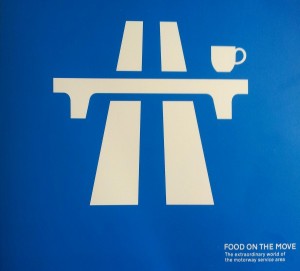
Author David Lawrence has spent racked up 11,000 miles of UK motorway driving and eaten breakfast in over 100 service stations for our pleasure. Now he has authored a new book on motorway food and architecture called Food on the Move: The Extraordinary World Of The Motorway Service Area – with contributions from figures as wide-ranging as Joan Bakewell, Alain de Botton and Jonathan Glancey – that includes 192 pages of colour photographs and stories from Britain’s highways.
Photos and stories from a world where Rolling Stones, film stars and Jimmy Savile rub shoulders with transvestites, drug dealers, and hitch-hikers. Lawrence discusses the romance of the Watford Gap, the beauty of Forton M6 and why we should love our service stations.
Service stations presumably offer one of the more unusual interactions between architecture and society. Is that what attracted you to them?
I’ve always been interested in places where people, design and movement come together. Having written the leading history of London’s tube station architecture, it made sense to move further afield and this is how I got my PhD in motorway service areas. There is a fascination for me in the way people migrate through these overlooked, neglected spaces where commerce, culture and human activity are all played out a high speed and full volume.
They’re a kind of place of accelerated but distant transactions, interactions and society?
Service areas are spaces of performance of every aspect of life. A few examples include the changing subtleties of fashion, hairstyle, body adornment and accent as you cross the country; the regular meeting of transvestites at one service area, where they can anonymously be ‘someone else’; and the poetic sadness of life ebbing and flowing around the small hours of the night, when reality is as distant as the journey’s origin or destination.
JG Ballard spoke of ‘the mystery of multi-storey car parks… the poetry of abandoned hotels’.
There is a deep melancholy in these apparently depthless places – love, loss, tragedy, joy, unexpected encounters, crime, intrigue – and many subtle oddities which these places seem to bring out in people, because everyone feels anonymous and therefore loses their self-consciousness.
The motor car was once aspirational, enterprising and liberating; motorways had a futurist sheen about them. As our relationships have changed with cars and motorways, how has our relationship changed with service stations?
When the motorways had their glory period – circa 1959-69 – there were few service stations, and those that there were came to be seen as glamourous venues, at which to stop and see – or be seen by – others in the newly affluent classes. But even then, the glamour was fading as service station operators struggled to make profits, staff the facilities and pay onerous rents to the Government. Consequently, the services acquired a reputation as being dirty, crowded and expensive.
This reputation prevailed through various difficult trading periods, with some operators taking out much more than they invested. The government did not manage the service station sector effectively or positively and, like the railways in Britain, society and commerce lost its way for a couple of decades. Things then began to improve, both in culinary and architectural terms, and now there are some very good service stations on most motorway routes.
Are the dubious reputations of motorway services deserved?
Reputations are hard to shake off – but the majority of service stations are no less clean and cheap than most British airports or railway stations. It is the feeling of being captive, and stressed by driving, which accentuates the perception.
Additionally, where we feel some sense of being ‘carried’ by the railways and airlines, when it comes to road use the very virtue of being autonomous means we are also ‘on our own’ with all the concomitant insecurities of being a hunter-gatherer in the surreal world of the motorway.
You once spent Christmas in a Travelodge. What was it like?
Yes I did, and an Easter. It was a mixture of being in the midst of everyone’s Christmas travels, and also very alone. I once also got into a motel bed which had not been changed since the previous occupants celebrated their wedding night – there was still confetti in the bed.
What is your book about?
I would say the book covers many different aspects of service station culture, design and life. The dynasties of families working at service stations are interesting, as was the woman whose entire career is encapsulated in a set of plastic name badges.
There are many stories in the book, including the meeting of Cream’s Jack Bruce and other pop stars at Watford Gap. Some service stations are haunted; others have been the subject of sinister goings on when snowed-in and isolated from society.
The book had its roots in a discussion I had with various individuals who wanted to see a history of Little Chef and Happy Eater, and who wondered why there was no book on motorway services. A niche appeared, and here we are!
Lots of people have met an unlikely celebrity in a service station – who’s yours?
Dame Joan Bakewell – and she’s in the book! Everyone who contributed to the book was approached directly with an invitation to join in with this endeavour in a committed but light-hearted way. Most people were flattered, some surprised, but all expressed a curiosity around service stations. I can’t think of anyone who said ‘no’.
Tebay Services M6 Northbound are my favourite. What are yours and why?
I’d agree with you on Tebay M6 Northbound for the down-home service. Architecturally, Forton M6 takes the chocolate chip muffin, and for camaraderie I have a soft spot for Watford Gap, where we made the Watford Gap musical in 2009.
How should we feel about service stations?
Service stations are now as much part of the heritage of modern Britain as Concorde, the Mini Cooper or Top of the Pops. They are necessary if not necessarily beautiful, and they give us a chance to both watch the world, and escape from our own lives, for the price of a reasonably good cup of coffee.
Food on the Move: The Extraordinary World Of The Motorway Service Area by David Lawrence is available to buy now. His previous book – Always A Welcome: The Glove Compartment History Of The British Motorway Service Area – is also available.
Originally written for MotorTorque.com
• Forton Servies image by Ian Paterson

